High Activity Enzyme Supplier: Industrial Specification Checklist
Compare high activity enzyme suppliers with a B2B checklist for specs, COA/TDS/SDS, pilot validation, cost-in-use, and qualification.

Use this B2B comparison guide to shortlist enzyme suppliers, validate performance under real process conditions, and request quotes with the data needed for confident procurement. To request a quote, send the product, quantity, pack and destination country through the quote form on our home page or by email to hello@mail.enzymeb2b.com.
How to Compare a High Activity Enzyme Supplier
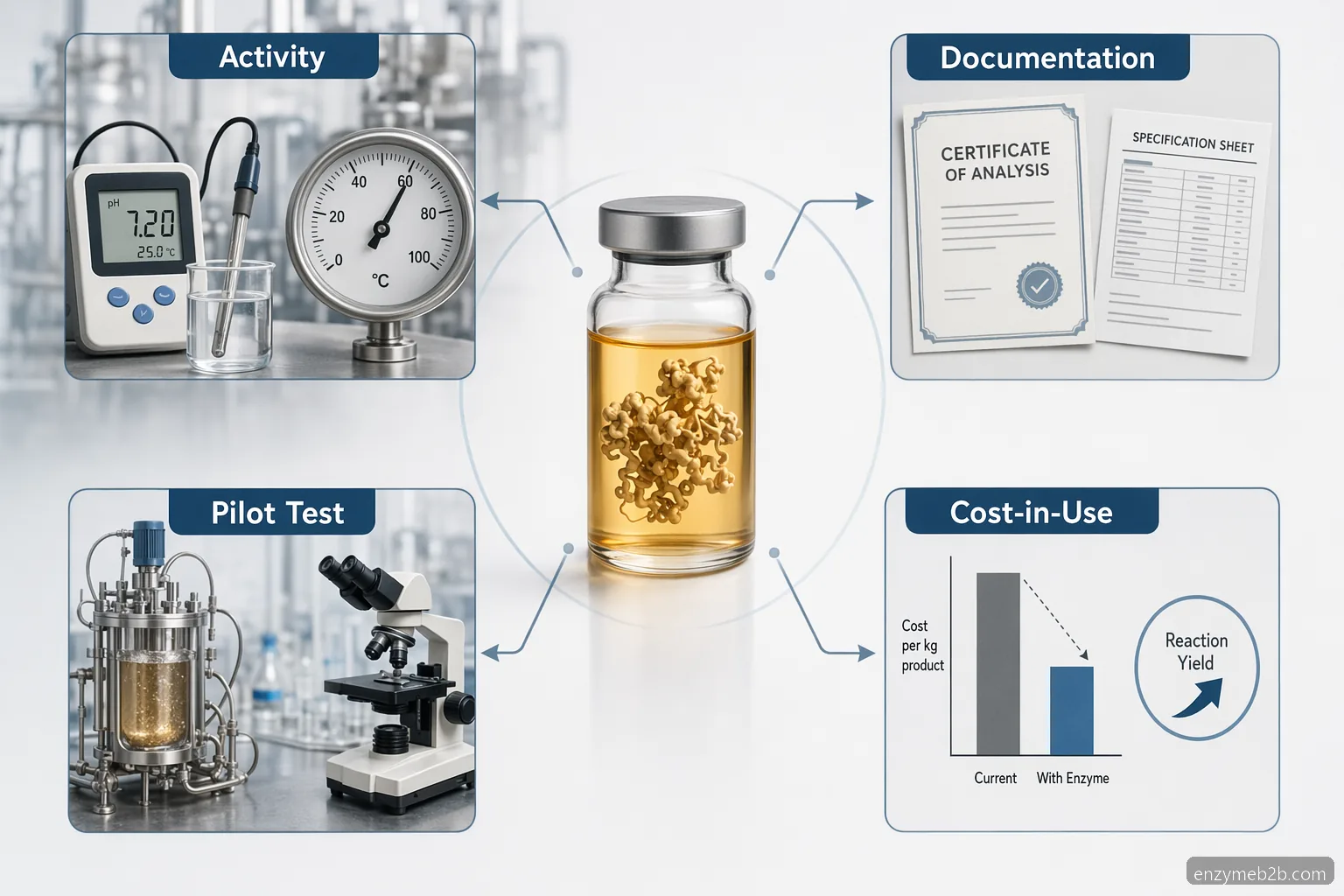
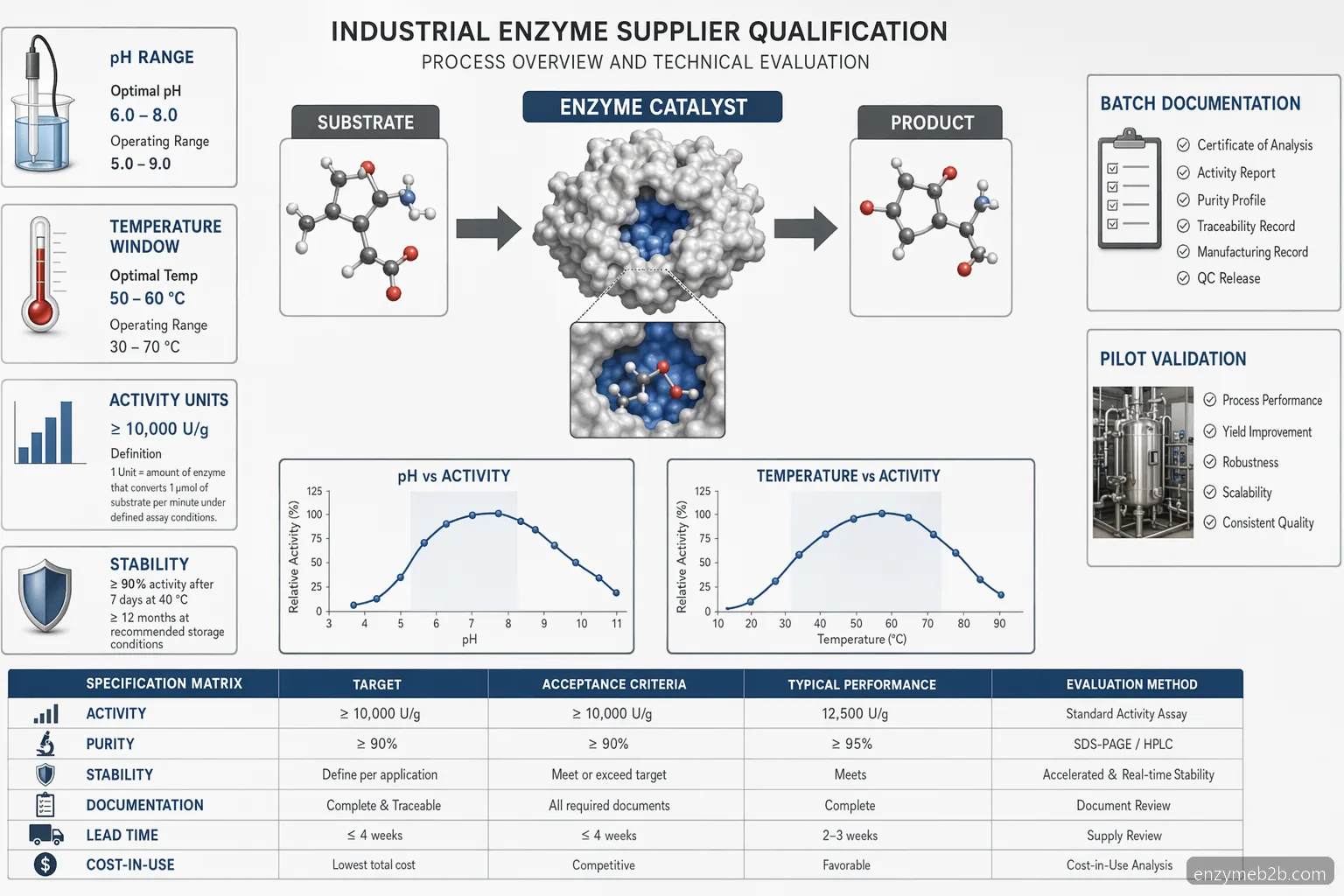
A high activity enzyme supplier should be evaluated on usable performance, not just units per gram or milliliter. Activity methods vary by enzyme class, substrate, assay pH, assay temperature, and reporting basis, so buyers should request the test method behind every specification. For general industrial applications, define the target reaction first: protein hydrolysis, starch conversion, viscosity control, fiber modification, cleaning, flavor development, or process yield improvement. Then compare enzyme candidates under realistic operating windows such as pH 4.0–9.0, 30–70°C, contact times from 15 minutes to several hours, and typical dosage bands of 0.01–1.0% w/w, depending on substrate and activity. A reliable enzyme supplier will help translate lab assay numbers into plant-scale trial conditions. When using an enzyme b2b marketplace, shortlist manufacturers and distributors that provide documentation, responsive technical support, and sample quantities for pilot validation.
Match enzyme class to substrate and process objective. • Confirm activity method and reporting units. • Compare performance at your real pH and temperature. • Ask for sample availability before commercial commitment.
Documents to Request Before Buying Enzymes Online
Before you buy enzymes online for production trials, request a complete technical package. The Certificate of Analysis should identify lot number, declared activity, appearance, microbial limits where applicable, moisture or solids content, and release date. The Technical Data Sheet should list enzyme source type, formulation, recommended pH and temperature range, storage conditions, shelf life, compatibility notes, and suggested dosage. The Safety Data Sheet should cover handling precautions, dust or aerosol controls, personal protective equipment, first-aid measures, and transport classification. For food, beverage, or ingredient processing, buyers may also require food grade status, allergen statements, GMO-related declarations where relevant, and kosher or halal documentation. A kosher halal enzyme supplier should provide current statements from recognized certification bodies without implying suitability beyond the stated certificate scope.
COA: lot-specific release data and activity. • TDS: use conditions, dosage, storage, and compatibility. • SDS: safe handling, PPE, and transport information. • Declarations: food grade, allergen, kosher, halal, or other required statements.
Pilot Validation for General Industrial Enzyme Use
Pilot validation is the bridge between supplier claims and production value. Start with a control batch and two to four enzyme dosages, such as 0.02%, 0.05%, 0.10%, and 0.20% w/w, adjusted for enzyme potency and substrate load. Record pH, temperature, agitation, contact time, solids level, and any pre-treatment conditions. For protease enzyme supplier comparisons, track degree of hydrolysis, soluble nitrogen, viscosity change, filtration rate, bitterness risk for food uses, or cleaning soil removal depending on the application. For carbohydrases, measure reducing sugars, dextrose equivalent, viscosity, or yield. For lipases, evaluate free fatty acid generation, esterification, or cleaning outcomes. Confirm whether performance declines after heat exposure, preservatives, salts, surfactants, oxidizers, or extreme pH. The best enzyme ingredient supplier will support trial design and help define pass/fail criteria before scale-up.
Run a no-enzyme control and multiple dosage points. • Measure process outcome, not only residual activity. • Check compatibility with salts, surfactants, preservatives, and heat. • Document scale-up assumptions before production trials.
Cost-in-Use Beats Price per Kilogram
For industrial enzyme purchasing, the lowest price per kilogram can be misleading. Cost-in-use includes delivered price, enzyme activity, required dosage, yield improvement, reduced processing time, energy savings, waste reduction, rework avoidance, and shelf-life losses from poor storage. A concentrated liquid or granulated enzyme may cost more per unit but use less material, reduce freight, or improve dosing accuracy. Buyers should normalize supplier quotes to activity delivered at the reactor, washer, mash tank, fermenter, or blending step. Ask each enzyme supplier quote request to include minimum order quantity, lead time, packaging, incoterms, storage requirements, sample policy, and available technical support. For comparison, calculate cost per treated metric ton, cost per batch, or cost per kilogram of finished output. This makes high activity enzyme supplier evaluation commercially meaningful.
Normalize quotes to cost per treated ton or batch. • Include freight, storage, shelf life, and waste. • Compare active performance under plant conditions. • Ask for MOQ, lead time, packaging, and incoterms.
Supplier Qualification and Marketplace Shortlisting
Supplier qualification should combine technical, quality, commercial, and service checks. Review enzyme supplier reviews carefully, but prioritize verifiable documents and trial performance over general ratings. Confirm whether the company is an industrial enzyme manufacturer, distributor, importer, or formulation partner, because responsibilities for traceability and change control may differ. Ask about batch traceability, retained samples, change notification, complaint handling, corrective actions, and continuity of supply. If sourcing for food processing, search specifically for relevant terms such as food grade protease enzyme supplier USA only when domestic stocking, local regulatory support, or shorter lead time is required. If you need an enzyme vitamin supplier, clarify whether the requirement is for industrial ingredient processing or dietary supplement channels, since documentation and intended use may differ. A strong marketplace makes these comparisons faster and more transparent.
Verify manufacturer, distributor, or formulation role. • Check traceability, change control, and complaint process. • Prioritize documented performance over generic reviews. • Separate industrial enzyme needs from supplement claims.
Technical Buying Checklist
Buyer Questions
A high activity enzyme supplier should provide more than a stronger label claim. Buyers need assay methods, lot-specific COA data, process-relevant pH and temperature guidance, and support for pilot trials. The practical difference is whether lower dosage, faster reaction time, improved yield, or better consistency is demonstrated in your process conditions.
Include enzyme class, application, substrate, batch size, pH, temperature, contact time, current dosage if any, target outcome, annual volume, required documents, packaging preference, and delivery location. Ask suppliers to quote sample quantity, commercial MOQ, lead time, incoterms, shelf life, and technical support. This reduces mismatched offers and speeds comparison.
No. Protease activity units depend on the assay substrate, pH, temperature, and endpoint method. Two proteases with similar labeled activity may perform differently in soy, dairy, meat, detergent, leather, or waste-processing systems. Compare suppliers through controlled trials measuring your target result, such as hydrolysis level, viscosity reduction, filtration, cleaning, or yield.
You need kosher or halal documentation when your finished product, customer specification, or production program requires it. Request current certificates or statements that identify the enzyme product, manufacturer or site where applicable, and certificate scope. Do not assume all food grade enzymes are kosher or halal; confirm documentation before purchasing or trial approval.
Enzyme supplier reviews can help identify responsiveness, communication quality, and delivery experience, but they should not replace technical qualification. Industrial buyers should prioritize COA/TDS/SDS completeness, sample performance, traceability, change control, and cost-in-use. Reviews are best used as a secondary signal after verifying documents and running a pilot.
Industrial Enzymes (Wholesale) for Research & Industry
Need Industrial Enzymes (Wholesale) for your lab or production process?
ISO 9001 certified · Food-grade & research-grade · Ships to 80+ countries
Frequently Asked Questions
What makes a high activity enzyme supplier different from a standard enzyme supplier?
A high activity enzyme supplier should provide more than a stronger label claim. Buyers need assay methods, lot-specific COA data, process-relevant pH and temperature guidance, and support for pilot trials. The practical difference is whether lower dosage, faster reaction time, improved yield, or better consistency is demonstrated in your process conditions.
How should I submit an enzyme supplier quote request?
Include enzyme class, application, substrate, batch size, pH, temperature, contact time, current dosage if any, target outcome, annual volume, required documents, packaging preference, and delivery location. Ask suppliers to quote sample quantity, commercial MOQ, lead time, incoterms, shelf life, and technical support. This reduces mismatched offers and speeds comparison.
Can I compare protease enzyme suppliers by activity units alone?
No. Protease activity units depend on the assay substrate, pH, temperature, and endpoint method. Two proteases with similar labeled activity may perform differently in soy, dairy, meat, detergent, leather, or waste-processing systems. Compare suppliers through controlled trials measuring your target result, such as hydrolysis level, viscosity reduction, filtration, cleaning, or yield.
When do I need a kosher halal enzyme supplier?
You need kosher or halal documentation when your finished product, customer specification, or production program requires it. Request current certificates or statements that identify the enzyme product, manufacturer or site where applicable, and certificate scope. Do not assume all food grade enzymes are kosher or halal; confirm documentation before purchasing or trial approval.
Are enzyme supplier reviews useful for industrial purchasing?
Enzyme supplier reviews can help identify responsiveness, communication quality, and delivery experience, but they should not replace technical qualification. Industrial buyers should prioritize COA/TDS/SDS completeness, sample performance, traceability, change control, and cost-in-use. Reviews are best used as a secondary signal after verifying documents and running a pilot.
Request a quote
Turn This Guide Into a Supplier Brief Request comparable enzyme supplier quotes with specifications, documents, samples, and pilot-support details.
Contact Us to Contributehello@mail.enzymeb2b.com