Enzyme Supplier Quote Request: What to Send for a Usable Quote
Request an enzyme quote you can act on: product or process, quantity, pack, destination, pH and temperature. For manufacturers, formulators and resellers.
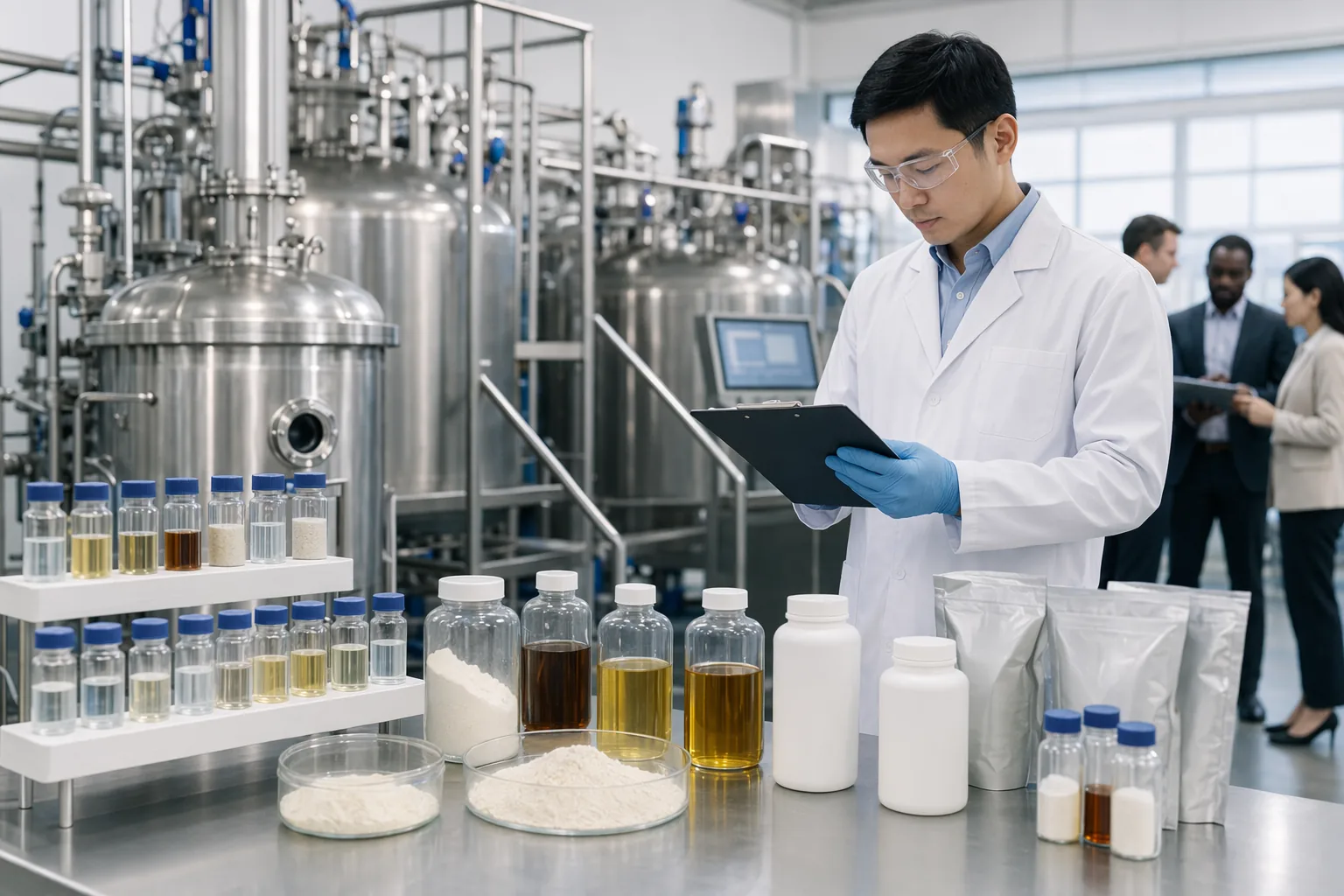
Most enzyme quotes go wrong before a price is written: the request names an enzyme but not the process, so the grade, the dose and the pack are guessed. This page is for purchasing teams, formulators and resellers buying enzymes for detergent, food, feed, textile or biofuel production who want a quote they can act on. Send the details below through the quote form on our home page or by email to hello@mail.enzymeb2b.com; we respond within 24 hours with a matched grade, pack and quote for your destination.
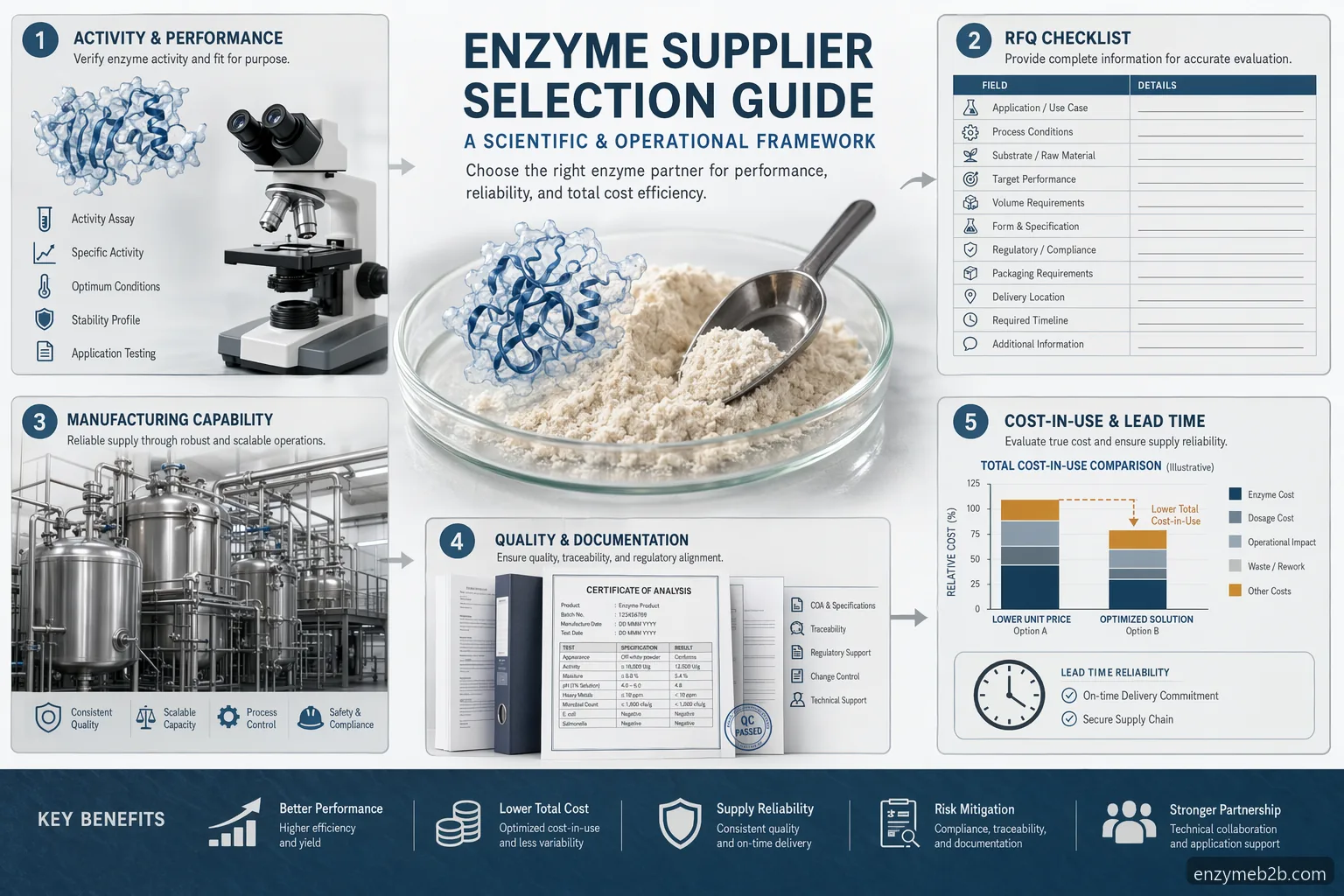
The five lines every quote request needs
1. Product or process: the enzyme if you know it; otherwise the process and the problem to solve, such as slow conversion, high viscosity, incomplete protein hydrolysis, starch carryover, foaming, odour or yield that varies from batch to batch.
2. Quantity: the first order and the expected volume per month or per year, so the quote reflects your real scale. The minimum order is 25 kg.
3. Pack and format: powder or liquid (availability depends on the enzyme), and 25 kg fiber drums or custom packaging if you repack or need another size for your line.
4. Destination: the delivery country and port or city, so freight and import paperwork are quoted with the goods.
5. Operating conditions: process pH, temperature, hold time and the dose you use today, if any. Without these we can only quote a catalogue grade, not the one that fits your line.
Details that change which grade we quote
pH: give the current value, the target and how far you can adjust it. Temperature: the hold time, the peak temperature and how fast the batch cools. Matrix: list salts, surfactants, oxidisers, chelators, solvents, oils or preservatives in the process, because they decide whether an enzyme keeps working at plant scale. Downstream: say whether a heat kill, a pH shift or a filtration step follows the enzyme. Format: a liquid is easier to dose by pump; a powder suits dry blends and storage but needs dust control and good dispersion.
Share pH as current, target and allowable adjustment. • Give the full temperature profile, not one number. • Name every additive in the matrix. • Say what happens after the enzyme step. • Request COA, TDS, and SDS with the quote.
Documentation, QC Checks, and Pilot Validation
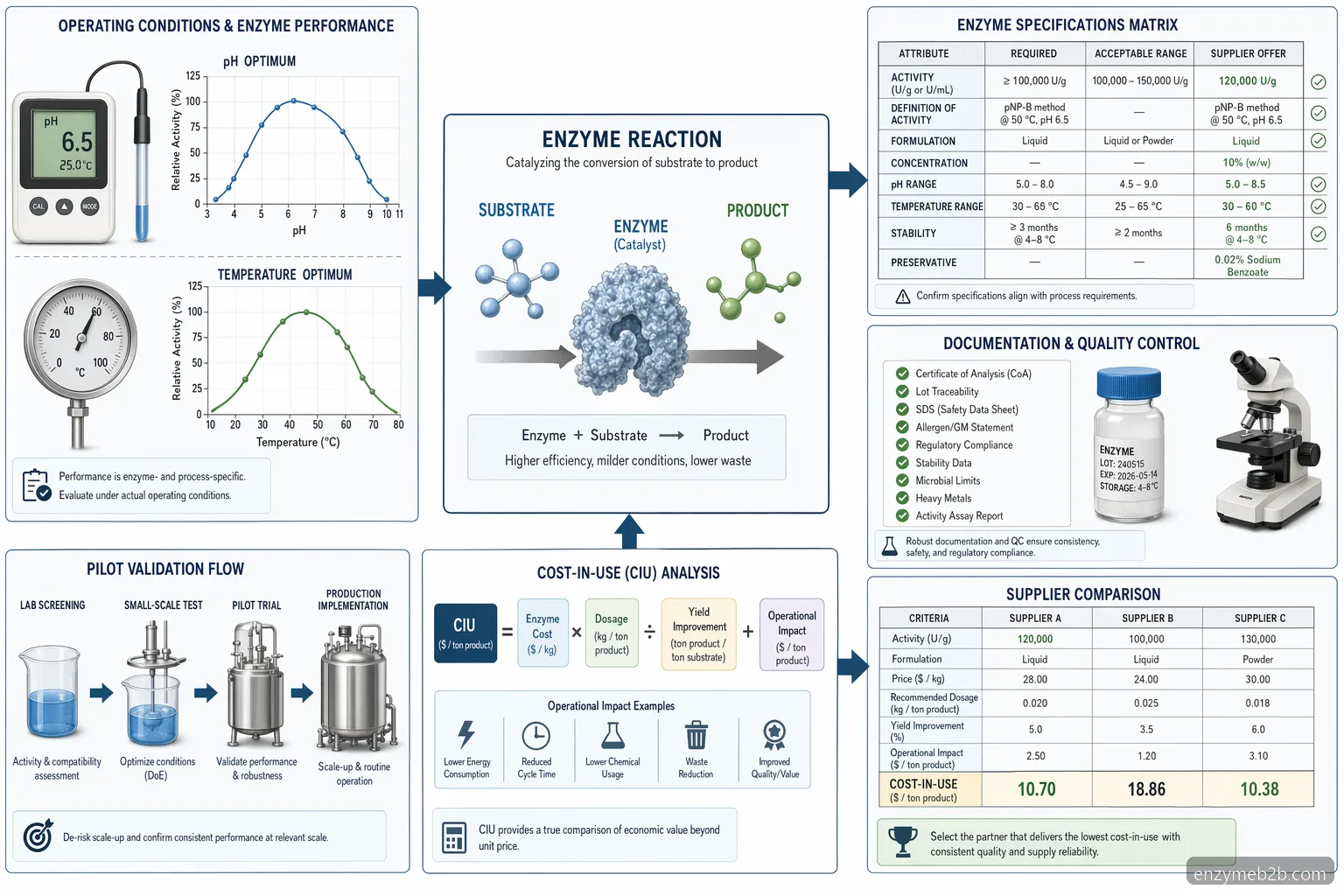
Before purchasing production volumes, request documents and perform quality checks that match your risk level. A COA should list lot number, assay activity, microbiological or impurity results where relevant, appearance, and release date. A TDS should explain application guidance, dosage range, solubility or dispersion behavior, storage, shelf life, and compatible process conditions. An SDS should support safe receiving, storage, handling, spill response, and worker training, especially because enzyme powders and aerosols may require dust or respiratory exposure controls. Pilot validation should compare at least two enzyme supplier options under the same substrate, pH, temperature, time, and dosage bands. Measure yield, viscosity, conversion, cleaning effect, texture change, filtration rate, or other process-specific endpoints. Retain samples, document deviations, and confirm whether lab-scale performance translates to plant mixing, heat transfer, and residence time.
Review COA, TDS, and SDS before approval. • Run matched pilot trials for fair comparison. • Measure process endpoints, not only activity. • Document lot number and storage history.
How to compare quotes once they arrive
Put every offer on the same basis before you look at price: the cost per tonne of substrate treated or per finished unit, not per kilogram of enzyme. That needs the activity and its assay method, the dose that reaches your target, the delivered cost including freight, the shelf life and the storage conditions. A concentrated grade can cost more per kilogram and less per batch; a cheap grade that needs double the dose, cold storage or a shorter shelf life is not cheap. Overdosing adds cost and can cause excessive hydrolysis, off-flavours or difficult separation; underdosing leaves conversion incomplete and stretches cycle time. Test candidates side by side: a no-enzyme control, your current product as the benchmark, and a low, medium and high dose under the same pH, temperature and mixing.
Compare cost per finished unit, not per kilogram. • Check that activity units are measured the same way. • Include freight, storage and shelf life. • Trial every candidate under identical conditions.
Buying to resell
Distributors and resellers should add the markets they sell into, the pack sizes their customers order and any packaging requirements. We quote the grade and pack to match: 25 kg fiber drums or custom packaging, from a minimum order of 25 kg.
Next step
Send the five lines above through the quote form on our home page or by email to hello@mail.enzymeb2b.com. If you already hold quotes from other suppliers, include them and we will point out which numbers are missing before you compare.
Industrial Enzymes (Wholesale) for Research & Industry
Need Industrial Enzymes (Wholesale) for your lab or production process?
ISO 9001 certified · Food-grade & research-grade · Ships to 80+ countries
Frequently Asked Questions
What should I include in an enzyme supplier quote request?
The product or the process and problem, the quantity for the first order and per year, the pack and format, the destination country, and the process pH, temperature, hold time and current dose. Add the documents you need with the quote. The more process detail you give, the closer the first quote is to the grade you will actually buy.
How do I compare two enzyme supplier quotes fairly?
Compare quotes on cost-in-use, not only price per kilogram. Normalize by activity, dosage, retained performance under your process conditions, yield effect, handling requirements, freight, shelf life, and waste impact. Run pilot trials using the same substrate, pH, temperature, mixing, and contact time. A more expensive enzyme may be lower cost overall if it reduces dose, improves throughput, or gives more consistent results.
What documents should an industrial enzyme supplier provide?
At minimum, request a COA for the specific lot, a TDS for use and storage guidance, and an SDS for safe handling. Depending on the application, you may also need origin statements, allergen information, food-grade documentation, kosher or halal documentation, microbiological specifications, or processing-aid statements. Confirm that documents apply to the exact product and production site being quoted.
How do I compare two protease enzyme supplier quotes?
Normalize each quote by activity unit, dosage needed to reach your endpoint, delivered cost, shelf-life, and handling format. Confirm that activity methods are comparable because one supplier’s unit definition may not equal another’s. Then test both enzymes under the same pH, temperature, time, and substrate conditions. The best choice is the grade with reliable performance, documentation, availability, and lowest validated cost-in-use.
What QC checks are useful during enzyme pilot trials?
Track pH, temperature, residence time, mixing order, dosage, and endpoint performance against an untreated control. Depending on application, measure viscosity, degree of hydrolysis, reducing sugars, filtration rate, yield, residual activity, microbial limits, moisture, solids, color, and odor. Retain samples from each condition and compare pilot results with the supplier’s COA and TDS expectations before approving commercial purchase.
Do you quote distributors and resellers?
Yes. Send the markets you sell into, the pack sizes your customers buy and your expected volume, and we quote the grade and packaging to match. The minimum order is 25 kg.
Request a quote
Send the product or process, quantity, pack and destination country to hello@mail.enzymeb2b.com and we reply with a matched grade and quote.
Contact Us to Contributehello@mail.enzymeb2b.com