Industrial Enzymes Supplier: Use an Industrial Enzyme Marketplace for General Industrial Formulations
Source industrial enzymes for general industrial formulations with COA/TDS/SDS review, pilot validation, QC checks, and cost-in-use guidance.
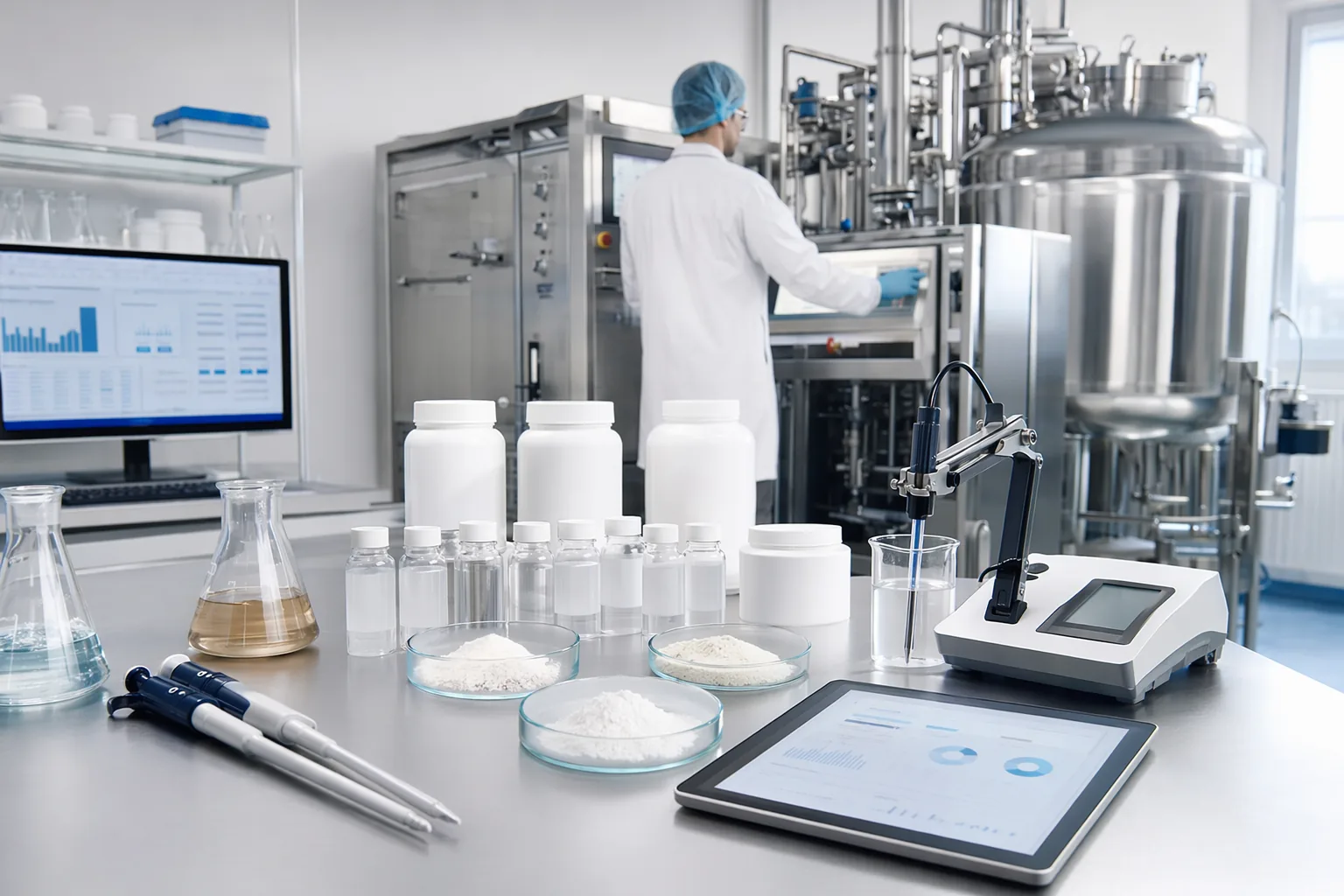
For purchasing teams, formulators, and process engineers, enzymeb2b.com helps compare qualified enzyme suppliers, technical documents, and formulation fit before scale-up.
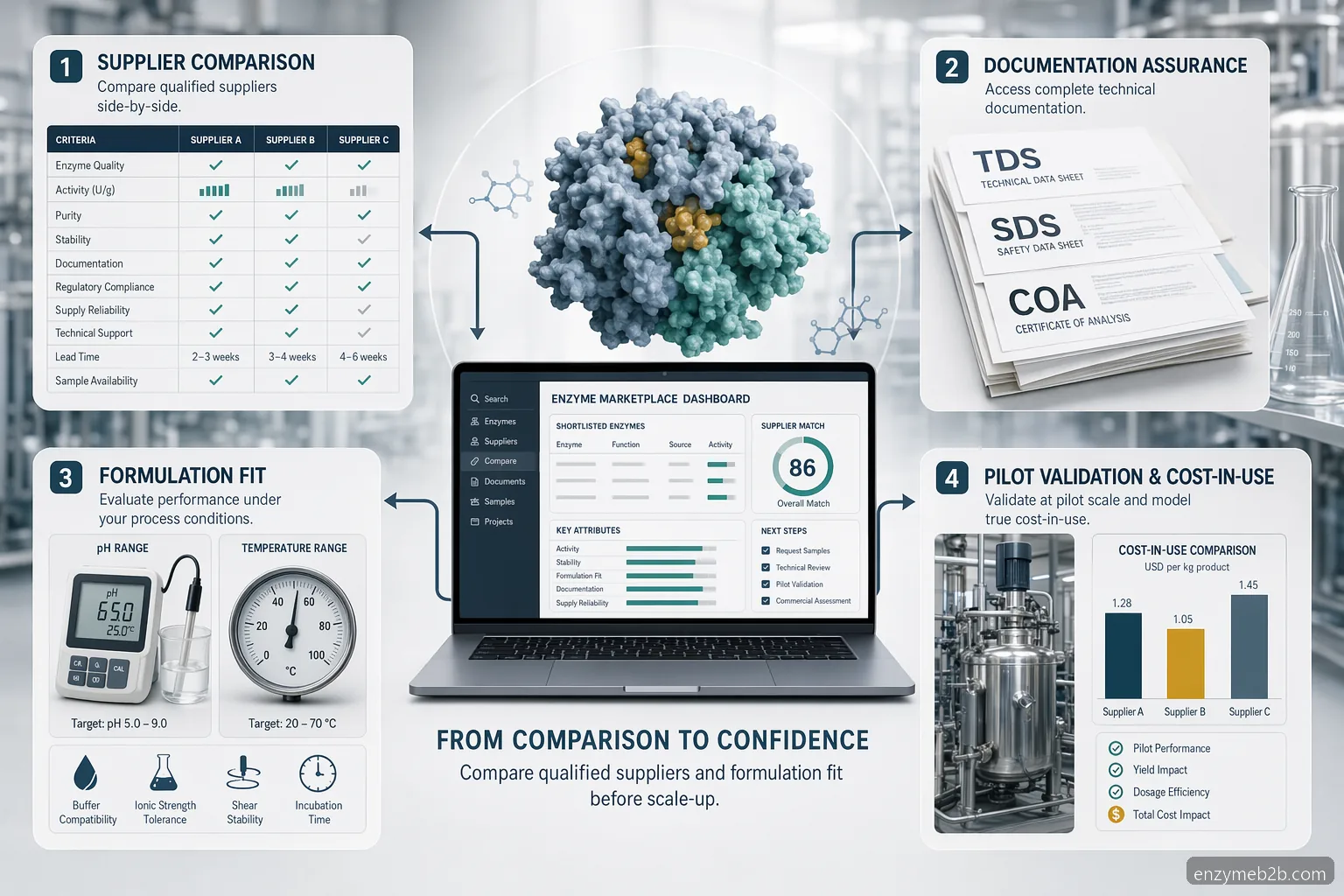
What an Industrial Enzymes Supplier Should Help You Confirm
A reliable industrial enzymes supplier should help buyers translate a formulation problem into a measurable process target. In general industrial use, that may mean reducing viscosity, improving hydrolysis, supporting cleaning efficiency, modifying fiber surfaces, or accelerating substrate breakdown. The supplier should clarify enzyme type, activity unit, carrier system, physical form, and compatibility with your raw materials. A cellulase enzymes industrial supplier, for example, should be able to explain how cellulase activity changes with cellulose source, pH, residence time, temperature, and shear. When using enzymeb2b.com as an enzyme b2b sourcing channel, compare suppliers by technical transparency, not only catalog breadth. Ask whether the product is liquid, powder, granule, or immobilized; whether it contains stabilizers; and how activity is measured. This reduces reformulation risk before you buy enzymes online supplier for general industrial trials.
Define substrate and desired conversion or modification. • Confirm enzyme class, activity unit, and analytical method. • Check form, carrier, solubility, and handling requirements. • Compare supplier responsiveness and document completeness.
Typical Process Conditions for General Industrial Enzyme Trials
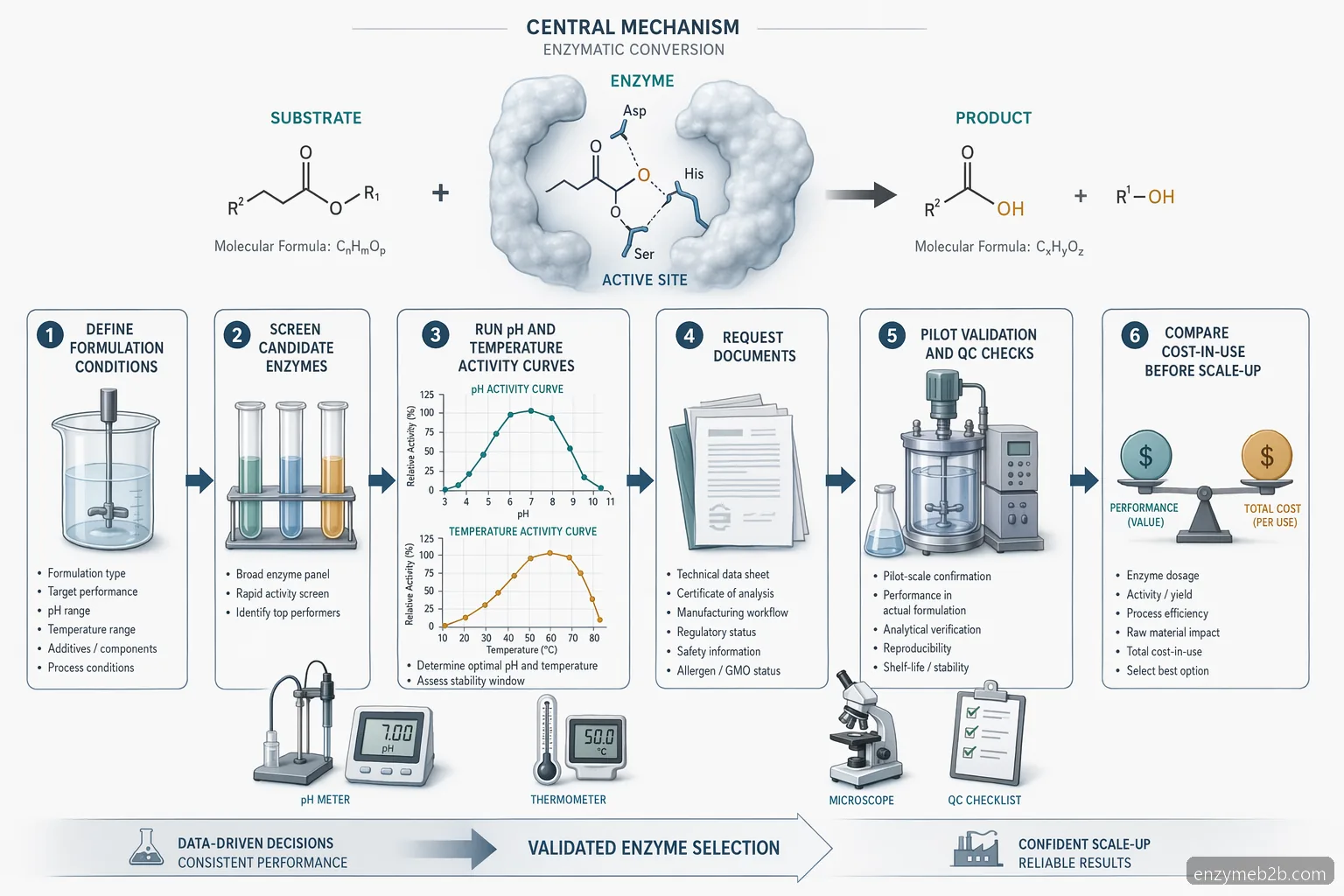
Industrial enzymes are highly process-dependent, so early screening should map performance across the likely operating window. Many carbohydrases, including cellulase, amylase, and hemicellulase systems, are commonly screened around pH 4.5–7.5 and 35–60°C, though specific grades may sit outside this range. Proteases may require neutral to alkaline conditions, often pH 7–10, depending on formulation chemistry and substrate. Initial dosage bands are frequently tested from 0.05–1.0% on substrate or 50–2,000 ppm in liquid systems, then refined by activity unit and reaction time. Avoid assuming that higher dose is always better; inhibition, instability, or downstream separation effects can change economics. For every enzyme supplier shortlist, request recommended starting conditions from the TDS and confirm them in your own matrix.
Screen pH, temperature, time, and dosage together. • Include a no-enzyme control and a heat-inactivated control where useful. • Track conversion, viscosity, turbidity, solids release, or cleaning endpoint. • Record any odor, color, foam, or sediment changes.
Documents to Request Before Sampling or Scale-Up
Before purchasing pilot quantities, ask each supplier of enzymes for a current certificate of analysis, technical data sheet, and safety data sheet. The COA should identify lot number, activity, specification limits, appearance, and release date. The TDS should explain recommended use level, pH and temperature stability, storage conditions, and shelf life. The SDS should support workplace risk assessment, especially for powdered enzymes that may require dust control and respiratory protection. If your procurement search includes adjacent categories such as vitamins enzymes supplier, bakery enzymes supplier, or a premium supplier of pancreatic enzymes for dogs, keep the requirement separate from industrial formulation sourcing and do not treat marketplace listings as medical, dietary, or veterinary advice. For industrial projects, documentation must match the intended plant environment and end-use regulatory review.
COA: lot-specific activity and release specifications. • TDS: process guidance, stability, dosage, and storage. • SDS: handling, exposure controls, transport, and disposal. • Traceability: batch number, manufacturing site, and retest date.
Pilot Validation and QC Checks That Reduce Purchasing Risk
Pilot validation should confirm that laboratory performance survives real raw materials, plant water, process shear, hold time, and downstream operations. Start with a small design of experiments covering the supplier’s recommended pH, temperature, and dose range. Measure the same response variables that matter commercially, such as throughput, filterability, yield, viscosity reduction, substrate conversion, cleaning time, or waste load. QC checks should include incoming appearance, activity confirmation where your lab has a method, pH, moisture for powders, density for liquids, and microbial limits if relevant to the application. Retain reference samples from approved lots to compare future deliveries. When two enzyme suppliers look similar, select the one that provides consistent technical support, clear change-notification practices, and practical troubleshooting during pilot scale.
Run bench screening before pilot batches. • Use plant-representative raw materials and water. • Confirm activity retention after storage and processing. • Create acceptance criteria before issuing a purchase order.
Cost-in-Use: How to Compare Enzymes Beyond Unit Price
The lowest quoted price per kilogram is rarely the best purchasing metric. Cost-in-use compares the dose needed to reach the target result, the enzyme activity per unit, losses during storage, labor requirements, process time, energy use, waste reduction, and any downstream impact. A concentrated liquid may cost more per kilogram but reduce dosing volume, while a powder may offer storage advantages but require dust controls and careful dispersion. When you buy enzymes online, request sample quantities from more than one industrial enzyme manufacturer or distributor and evaluate them against the same operating conditions. Track cost per treated ton, cost per batch, or cost per unit conversion. This creates a defensible comparison for procurement, R&D, quality, and operations before supplier approval.
Normalize by activity unit and effective dosage. • Include storage, handling, dilution, and downtime costs. • Compare performance at realistic residence times. • Review lead time, MOQ, packaging size, and payment terms.
Technical Buying Checklist
Buyer Questions
Start with the substrate, operating pH, temperature, residence time, and target performance metric. Shortlist suppliers that provide clear COA, TDS, and SDS documents, explain activity units, and support bench trials. Ask for recommended dosage ranges and storage requirements. Then compare pilot results, batch consistency, lead time, packaging, and cost-in-use before approving a commercial supplier.
Request a current certificate of analysis, technical data sheet, and safety data sheet for the exact product and lot whenever possible. The COA should show activity and specification limits. The TDS should cover use level, pH, temperature, stability, and shelf life. The SDS should support handling controls, especially for powders where enzyme dust exposure may be a workplace concern.
Use the supplier’s TDS as the first reference, then test a structured dosage range. Many preliminary studies evaluate about 0.05–1.0% on substrate or 50–2,000 ppm in liquid processes, depending on enzyme activity and substrate load. Always include a control and measure a commercial endpoint, such as viscosity, conversion, yield, cleaning time, or filtration rate.
Price per kilogram ignores activity level, effective dose, storage losses, handling time, process speed, and downstream effects. A higher-priced enzyme may reduce batch time, energy use, rework, or waste, while a cheaper grade may require more product to reach the same endpoint. Cost-in-use converts supplier options into a practical operating comparison for procurement and process teams.
Related Search Themes
cellulase enzymes industrial supplier, buy enzymes online supplier for general industrial, enzymes supplier, enzyme supplier, vitamins enzymes supplier, bakery enzymes supplier
Industrial Enzymes (Wholesale) for Research & Industry
Need Industrial Enzymes (Wholesale) for your lab or production process?
ISO 9001 certified · Food-grade & research-grade · Ships to 80+ countries
Frequently Asked Questions
How do I choose an industrial enzymes supplier for a new formulation?
Start with the substrate, operating pH, temperature, residence time, and target performance metric. Shortlist suppliers that provide clear COA, TDS, and SDS documents, explain activity units, and support bench trials. Ask for recommended dosage ranges and storage requirements. Then compare pilot results, batch consistency, lead time, packaging, and cost-in-use before approving a commercial supplier.
What documents should I request before I buy enzymes online?
Request a current certificate of analysis, technical data sheet, and safety data sheet for the exact product and lot whenever possible. The COA should show activity and specification limits. The TDS should cover use level, pH, temperature, stability, and shelf life. The SDS should support handling controls, especially for powders where enzyme dust exposure may be a workplace concern.
What is a practical starting dosage for general industrial trials?
Use the supplier’s TDS as the first reference, then test a structured dosage range. Many preliminary studies evaluate about 0.05–1.0% on substrate or 50–2,000 ppm in liquid processes, depending on enzyme activity and substrate load. Always include a control and measure a commercial endpoint, such as viscosity, conversion, yield, cleaning time, or filtration rate.
Why compare cost-in-use instead of price per kilogram?
Price per kilogram ignores activity level, effective dose, storage losses, handling time, process speed, and downstream effects. A higher-priced enzyme may reduce batch time, energy use, rework, or waste, while a cheaper grade may require more product to reach the same endpoint. Cost-in-use converts supplier options into a practical operating comparison for procurement and process teams.
Ready to source?
Turn This Guide Into a Supplier Brief Compare qualified enzyme suppliers, request COA/TDS/SDS, and start pilot-ready sourcing on enzymeb2b.com.
Contact Us to Contribute