Kosher Halal Enzyme Supplier: Industrial Marketplace Checklist
Compare kosher halal enzyme suppliers for industrial use: specs, COA/TDS/SDS, pilot trials, cost-in-use, QC, and quote request criteria.

Use this B2B checklist to compare qualified enzyme suppliers, request comparable quotes, and validate performance before scaling general industrial processes.
How to Compare Kosher and Halal Enzyme Suppliers
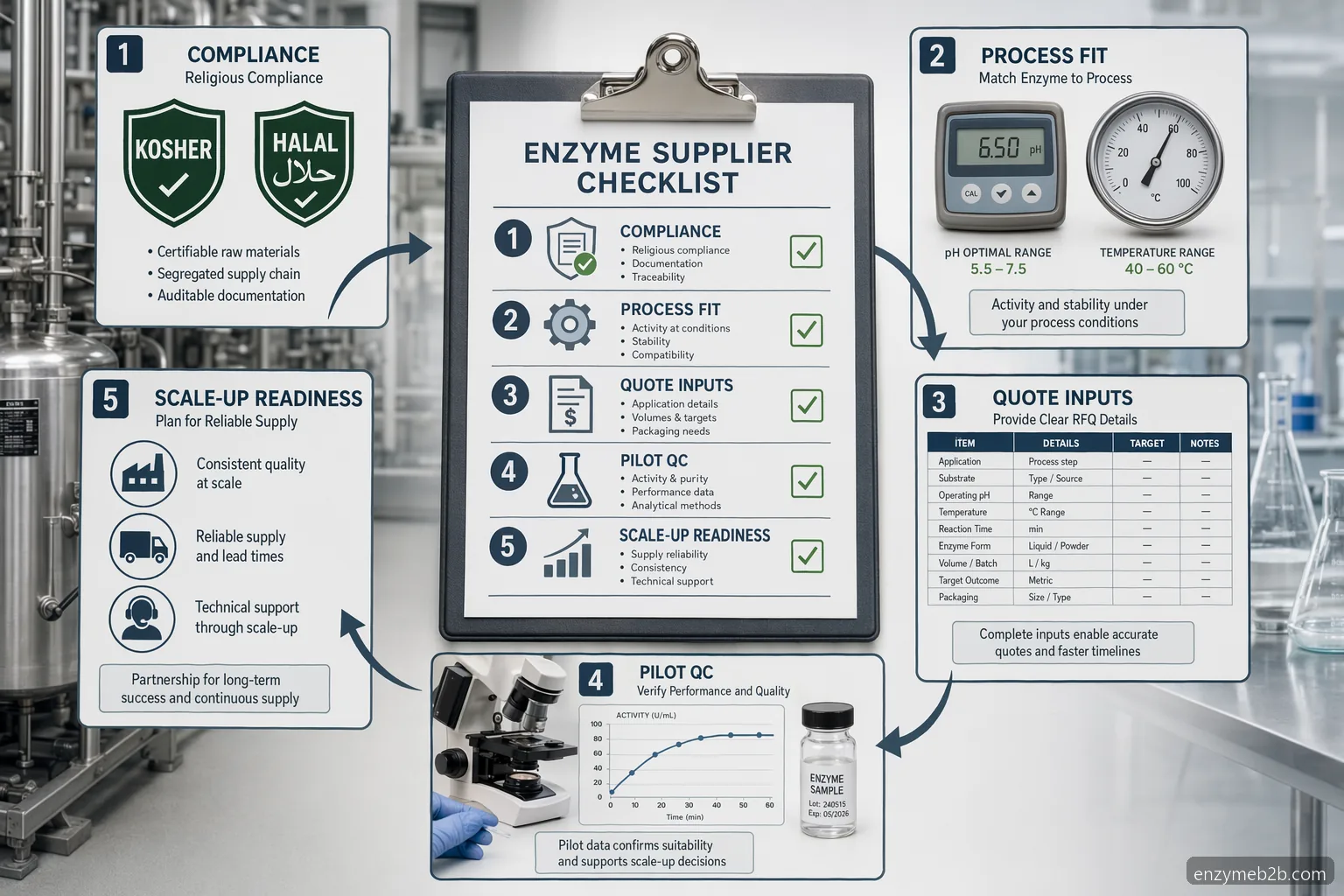
A kosher halal enzyme supplier should be evaluated as a technical manufacturing partner, not only a catalog source. For general industrial buyers, the first comparison point is whether the supplier can provide documentation that matches your intended market, plant controls, and customer requirements. Request the current Certificate of Analysis, Technical Data Sheet, Safety Data Sheet, manufacturing origin statement, animal-origin statement when relevant, and kosher or halal documentation where applicable. Avoid accepting vague verbal assurances; documentation should identify product code, lot traceability, activity method, shelf life, storage, and handling guidance. If the enzyme is used in food-contact or food-processing applications, confirm whether food-grade status is supported by the supplier’s documentation. A strong enzyme ingredient supplier will also explain limitations, such as processing aids, carriers, preservatives, or fermentation-derived materials that may affect customer approval.
Confirm lot-level COA availability before ordering. • Ask whether kosher or halal documentation applies to the exact product code. • Check whether carriers and stabilizers meet your use case. • Separate food, feed, detergent, textile, and technical-grade requirements.
Process Conditions Matter More Than Catalog Claims
Industrial enzymes perform within defined operating windows, so supplier comparison should include your actual process conditions. For protease, amylase, cellulase, lipase, and other industrial enzymes, request pH activity curves, temperature profiles, thermal stability data, and recommended dosage bands. As a starting point, many proteases are screened around pH 6.0–10.5 and 35–65°C, while some specialty enzymes operate outside those ranges. Typical trial dosage may begin around 0.01–0.50% w/w of substrate or 50–2,000 ppm, depending on activity, contact time, and substrate load. These are screening bands, not final specifications. A high activity enzyme supplier should state the activity unit definition and assay method so you can compare potency accurately. Without comparable activity units, a lower-cost enzyme may underperform once diluted into real production conditions.
Request activity unit definitions and assay methods. • Screen pH, temperature, dosage, and time together. • Validate compatibility with salts, surfactants, solvents, and preservatives. • Measure final yield, viscosity, hydrolysis degree, or cleaning efficiency.
Building a Comparable Enzyme Supplier Quote Request
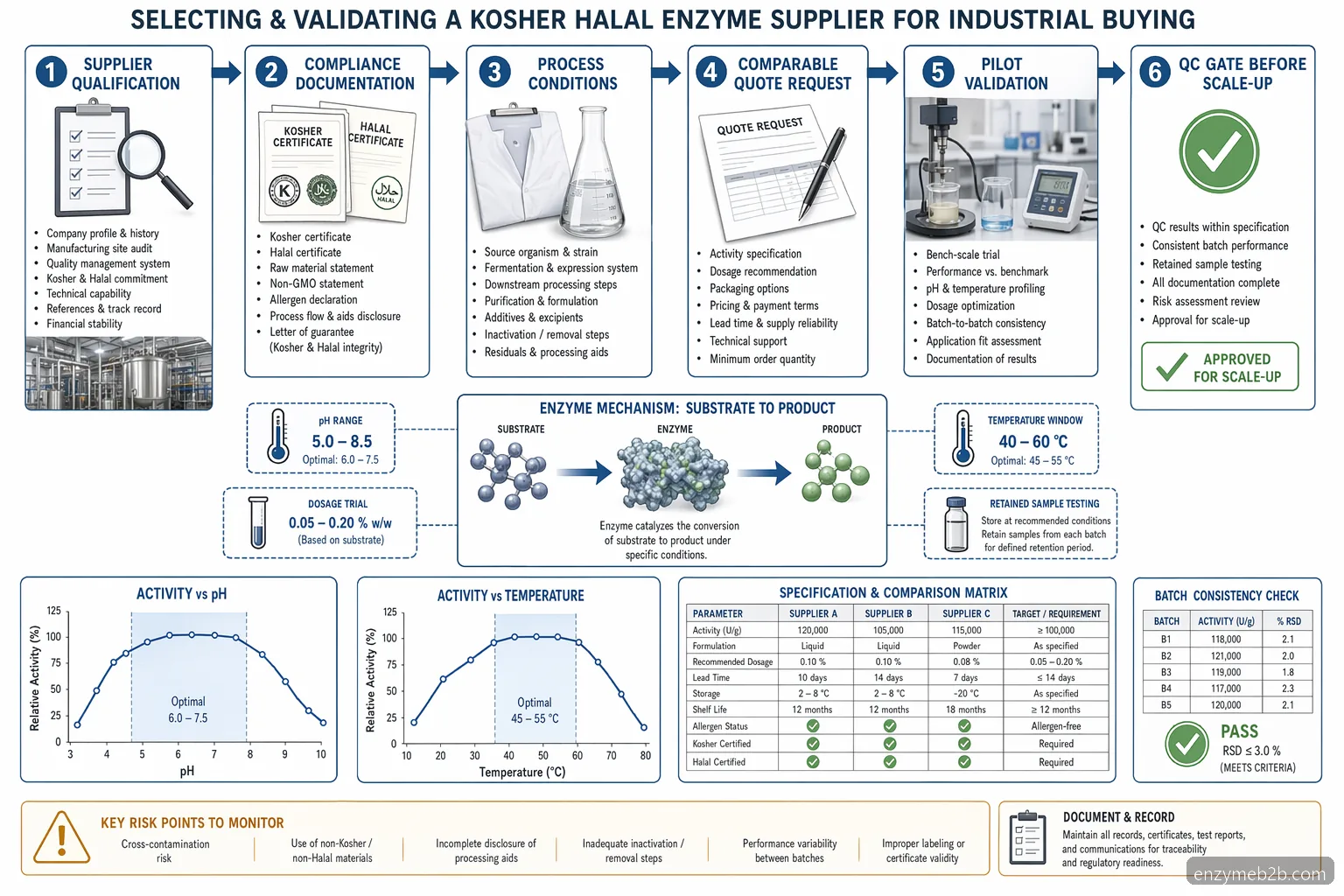
An effective enzyme supplier quote request makes bids comparable and reduces delays. Include your application, substrate, annual volume estimate, target process temperature, pH range, batch or continuous operation, contact time, regulatory market, and preferred format such as liquid, powder, granule, or immobilized preparation. Ask each enzyme supplier to quote by product code, activity, packaging size, minimum order quantity, lead time, incoterms, shelf life, storage condition, and sample availability. For buyers searching for a food grade protease enzyme supplier USA, also clarify whether domestic stocking, import documentation, and lot release timing are required. If your purchasing team is comparing an enzyme vitamin supplier against an industrial enzyme ingredient supplier, separate supplement-oriented documentation from industrial processing needs. Supplier reviews may be helpful for service signals, but technical validation should drive selection.
Provide target annual volume and trial quantity. • Ask for sample, pilot, and production pricing. • Request COA, TDS, SDS, and specification limits with the quote. • Compare total landed cost and cost-in-use.
Pilot Validation and QC Checks Before Scale-Up
Pilot validation should mimic the plant, not an idealized lab condition. Use representative raw materials, normal water quality, expected pH adjustment chemicals, production mixing, and realistic hold times. Establish a control run without enzyme and at least three enzyme dosage levels, such as low, target, and high. Record temperature drift, pH drift, residence time, agitation, substrate solids, and endpoint performance. Depending on the process, QC checks may include enzyme activity confirmation, moisture, microbial limits, heavy metals where relevant, particle size for powders, viscosity change, degree of hydrolysis, reducing sugar release, protein solubilization, or cleaning performance. Confirm downstream effects such as filtration rate, foaming, color, odor, or inactivation requirements. Pilot data should support a cost-in-use model that includes enzyme dose, yield gain, waste reduction, cycle time, and quality impact.
Run a no-enzyme control and multiple dosage levels. • Verify lot activity against the supplier COA. • Check whether heat, pH, or chemical inactivation is needed. • Document both performance gains and downstream side effects.
Supplier Qualification for Industrial Enzyme Buying
Supplier qualification should cover technical, quality, commercial, and continuity risks. Ask whether the supplier is a manufacturer, distributor, or marketplace partner, and confirm who controls formulation, QC release, and change notification. An industrial enzyme manufacturer may offer deeper process support, while a marketplace can help compare multiple qualified options. Either way, require clear specifications, traceability, sample policy, complaint handling, and notification of changes to strain, carrier, activity, manufacturing site, or packaging. Review storage and logistics risks, especially for liquid enzymes that may require cool, dry, or temperature-controlled handling. Compare payment terms, lead times, reserve stock options, and alternate enzyme availability. A qualified kosher halal enzyme supplier should help your team document fit-for-purpose approval without overclaiming regulatory, religious, or performance status beyond the evidence provided.
Confirm manufacturer, distributor, or marketplace role. • Require change notification for critical product attributes. • Review logistics, storage, and shelf-life controls. • Maintain an approved alternate when production risk is high.
Technical Buying Checklist
Buyer Questions
Request the COA, TDS, SDS, specification sheet, product code, lot traceability, shelf life, storage guidance, and kosher or halal documentation where applicable. The documents should apply to the exact enzyme grade being quoted, not a similar item. Also ask for activity method, carrier information, allergen or animal-origin statements when relevant, and change notification practices.
Compare protease products by activity unit definition, assay method, pH profile, temperature profile, stability, recommended dosage, and pilot performance. A protease enzyme supplier with a higher activity number is not automatically better unless the methods are comparable. Run side-by-side trials using your real substrate, pH, temperature, contact time, and endpoint metrics, then calculate cost-in-use.
Not necessarily. The lowest price per kilogram can be misleading if activity is lower, dosage is higher, shelf life is shorter, or technical support is limited. Compare delivered cost, required dose, process yield, batch time, waste reduction, QC burden, and supply reliability. A structured enzyme supplier quote request helps expose the true cost-in-use across competing offers.
Enzyme supplier reviews can indicate responsiveness, delivery consistency, and customer service, but they should not replace technical qualification. Industrial buyers should verify documentation, lot-specific COA data, pilot results, change controls, and supply continuity. Reviews are most useful as a secondary signal after confirming that the enzyme meets your specification and performs under real process conditions.
Before you buy enzymes online for industrial use, test the enzyme at your expected pH, temperature, substrate concentration, residence time, and mixing conditions. Include a no-enzyme control and several dosage levels. Track performance endpoints such as yield, viscosity, hydrolysis, cleaning result, filtration, or cycle time, plus downstream impacts like foaming, odor, inactivation, and product quality.
Industrial Enzymes (Wholesale) for Research & Industry
Need Industrial Enzymes (Wholesale) for your lab or production process?
ISO 9001 certified · Food-grade & research-grade · Ships to 80+ countries
Frequently Asked Questions
What should I request from a kosher halal enzyme supplier?
Request the COA, TDS, SDS, specification sheet, product code, lot traceability, shelf life, storage guidance, and kosher or halal documentation where applicable. The documents should apply to the exact enzyme grade being quoted, not a similar item. Also ask for activity method, carrier information, allergen or animal-origin statements when relevant, and change notification practices.
How do I compare two protease enzyme suppliers?
Compare protease products by activity unit definition, assay method, pH profile, temperature profile, stability, recommended dosage, and pilot performance. A protease enzyme supplier with a higher activity number is not automatically better unless the methods are comparable. Run side-by-side trials using your real substrate, pH, temperature, contact time, and endpoint metrics, then calculate cost-in-use.
Is the lowest enzyme quote the best option?
Not necessarily. The lowest price per kilogram can be misleading if activity is lower, dosage is higher, shelf life is shorter, or technical support is limited. Compare delivered cost, required dose, process yield, batch time, waste reduction, QC burden, and supply reliability. A structured enzyme supplier quote request helps expose the true cost-in-use across competing offers.
Can I use supplier reviews to qualify an enzyme supplier?
Enzyme supplier reviews can indicate responsiveness, delivery consistency, and customer service, but they should not replace technical qualification. Industrial buyers should verify documentation, lot-specific COA data, pilot results, change controls, and supply continuity. Reviews are most useful as a secondary signal after confirming that the enzyme meets your specification and performs under real process conditions.
What pilot conditions should I test before buying enzymes online?
Before you buy enzymes online for industrial use, test the enzyme at your expected pH, temperature, substrate concentration, residence time, and mixing conditions. Include a no-enzyme control and several dosage levels. Track performance endpoints such as yield, viscosity, hydrolysis, cleaning result, filtration, or cycle time, plus downstream impacts like foaming, odor, inactivation, and product quality.
Ready to source?
Turn This Guide Into a Supplier Brief Request comparable enzyme supplier quotes with COA, TDS, SDS, pilot samples, and cost-in-use guidance.
Contact Us to Contributehello@mail.enzymeb2b.com